About prices:prices on this page are US street prices in USD, last checked November 2026 for GPUs, Ryzen CPUs, and desktop RAM, and October 2026 for other parts. They are for reference only. Local prices differ by region and usually include VAT or sales tax, and availability changes quickly, so check the retailer before you buy.
Short answer: buy on VRAM and memory bandwidth, compare the price with recent sold listings, and only pay through a service that lets you return the card. After it arrives, confirm its identity, run a VRAM test for at least 6 minutes, then hold a real AI load for 15 to 30 minutes. For most local LLM builds, the used RTX 3090 remains the best single card at a $1,661 median eBay sold price. The RTX 3060 12GB, at $345, is the budget pick.
Quick Navigation:
The 10-Point Checklist
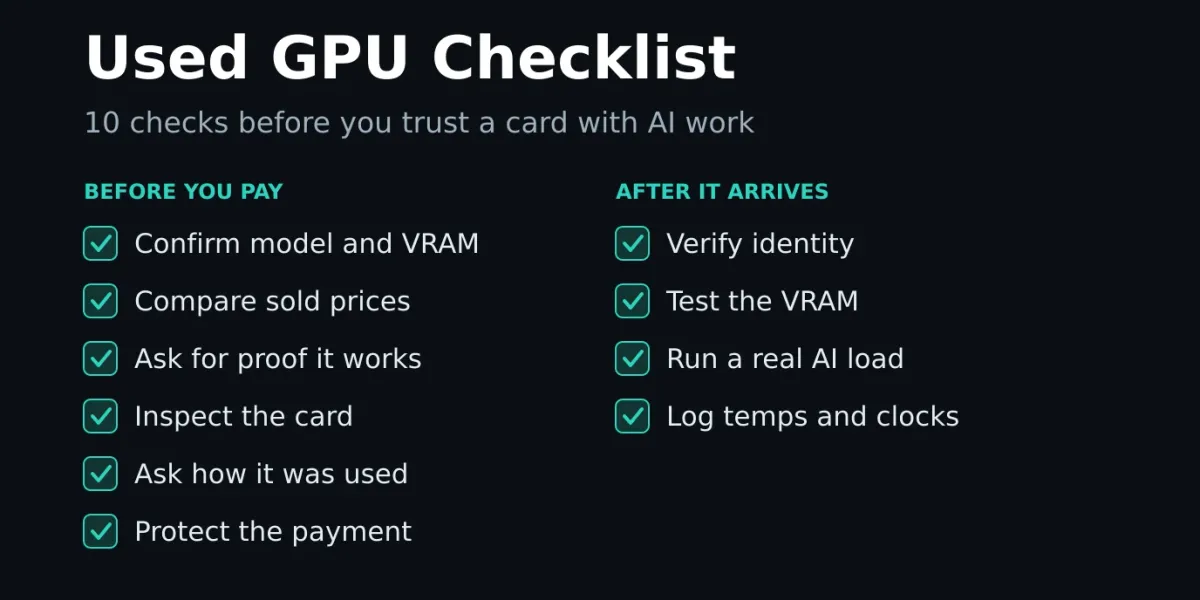
Use the first six checks before you pay and the last four as soon as the card arrives. If a card fails after delivery, stop testing and open a return while you are still covered.
Before you pay
- Confirm the exact model and VRAM. “RTX 3060” can mean 8GB or 12GB, and the difference decides which models fit. Ask for a GPU-Z or
nvidia-smiscreenshot showing the card. - Compare with sold prices, not asking prices. Use completed sales on eBay or a tracker such as GPU Sold. A price far below the median is a warning sign, especially on a new seller account.
- Ask for proof that it works. A short video or a photo of the card under load, with the seller’s username or the date on a note, is a reasonable request.
- Look at the physical condition. Check for bent fins, damaged fan blades, missing screws, corrosion, burnt power connectors, and a scratched PCIe edge connector. Disturbed screws can simply mean a repaste, so ask.
- Ask how it was used. Gaming, mining, and rendering are all acceptable answers. A seller who answers clearly is more useful than one who promises it was “never mined”.
- Protect the payment. Use a platform with buyer protection and avoid bank transfers, crypto, and friends-and-family payments. Check whether any remaining warranty transfers, because manufacturers handle this differently.
After it arrives
- Verify its identity. On Linux, this shows what the driver actually sees:
nvidia-smi --query-gpu=name,memory.total,vbios_version,pcie.link.gen.max,pcie.link.width.max,power.limit --format=csv- Test the VRAM. Run memtest_vulkan for at least 6 minutes, as its developers recommend. Any reported error means the system has a hardware problem. A clean run is good evidence but not a guarantee, because the tool cannot reliably catch rare, low-frequency errors.
- Run a real AI load. Load a model that uses most of the VRAM and keep it generating for 15 to 30 minutes. Watch for driver resets, CUDA errors, garbled output, or a sudden speed drop.
- Log temperature, power, and clocks. This command prints a reading every 5 seconds:
nvidia-smi --query-gpu=temperature.gpu,power.draw,clocks.sm,clocks.mem,utilization.gpu --format=csv -l 5If clocks fall while temperature climbs, the card is throttling. On GDDR6X cards such as the RTX 3090, also check the memory junction temperature with HWiNFO on Windows, since nvidia-smi usually does not report it on GeForce cards. Worn thermal pads are a common age-related problem and are often repairable, but they should be reflected in the price.
What Used GPUs Cost Now
The table uses GPU Sold medians as of November 21, 2026. They are completed US eBay sales including shipping, and they exclude multi-card lots and watercooled cards. The price per GB is our calculation.
| Used GPU | VRAM | Bandwidth | Sold median | Per GB | Sales counted |
|---|---|---|---|---|---|
| RTX 3060 12GB | 12GB | 360 GB/s | $345 | $28.75 | 302 |
| RTX 5070 | 12GB | 672 GB/s | $800 | $66.67 | 113 |
| RTX 3090 | 24GB | 936 GB/s | $1,661 | $69.21 | 295 |
| RTX 4080 | 16GB | 717 GB/s | $1,161 | $72.56 | 49 |
| RTX 5070 Ti | 16GB | 896 GB/s | $1,278 | $79.88 | 80 |
| RTX 4090 | 24GB | 1,008 GB/s | $3,050 | $127.08 | 104 |
Used prices move quickly and trackers do not always agree. For the RTX 3090, Get PC Parts reported a $1,093 average on October 24, while GPU Sold showed a $1,661 median a month later. Check the current sold listings for your exact card on the day you buy.
Which card to buy
- Tightest budget: RTX 3060 12GB. It is by far the cheapest VRAM here and comfortably runs smaller quantized models. Its 360 GB/s of bandwidth is the tradeoff.
- Best all-round: RTX 3090. It gives you 24GB and nearly the bandwidth of a 4090 for about half the price. Our GPU buying guide compares it with new cards.
- Need warranty or lower power: RTX 5070 Ti. It has less VRAM than a 3090, but it is a newer card with FP8 support and may still be under warranty.
- Need the fastest 24GB card: RTX 4090. It only makes sense if you can use its compute speed, because you pay nearly twice as much as a 3090 for the same memory.
Two 3060s cost about $690 and add up to 24GB, but the model has to be split across them. Our multi-GPU Ollama guide explains when that works.
Are Mining Cards Worth It?
The cheapest VRAM on the used market is on retired mining cards. In October, a Reddit user reported buying a complete rig with nine 6GB P106 cards for 3,000 rubles, about $35, for 54GB of total VRAM. Guru3D’s write-up relays the owner’s self-reported result of more than 30 tokens per second on a Qwen3.6 35B-A3B-class model.
That price was a lucky find. Bought separately in October, nine cards from a lot cost about $155 to $190, which is still only about $3 to $4 per GB. Before you copy the idea, know what you are giving up:
- Slow links. Mining frames usually connect each card through a PCIe x1 riser, which hurts any workload that moves data between cards.
- Old architecture. The P106 has 6GB of GDDR5, about 192 GB/s of bandwidth, and no Tensor Cores.
- Dead-end software. NVIDIA driver support stops at the 580 branch, and CUDA 13 removed Pascal. Modern PyTorch builds and some optimizations will not work.
- Power. Nine 120W cards have a 1,080W ceiling, although real inference usually draws less.
- No display output. These cards are harder to test and almost impossible to resell to gamers.
A P106 rig is a good weekend experiment if you enjoy tinkering and have cheap power. For dependable daily use, one RTX 3060 or 3090 will cause far fewer problems.
Mainstream cards that were once mined are a different case. An RTX 3090 used for mining can be perfectly healthy if the fans, memory temperatures, and test results are good. Judge the card in front of you, and use the history to negotiate.
When Not to Buy Used
Skip the used market if you need a warranty for business use, cannot tolerate downtime, or only need a large GPU occasionally. For short projects, renting is often cheaper. Our cloud vs local GPU guide works out the break-even point. If the model is only slightly too large, try a smaller quantization before you spend more.
FAQ
What should I check before buying a used GPU for AI?
Confirm the exact model and VRAM, compare the price with recent sold listings, ask for a photo of the card running, check the fans and PCIe connector, and make sure you have return protection. After it arrives, verify the card in nvidia-smi or GPU-Z, run a VRAM test for at least 6 minutes, and watch temperatures under a sustained load.
Is a used mining GPU safe to buy?
It can be. Mining history alone does not make a card bad. Fans, memory cooling, test results, price, and return protection matter more. Be stricter with cards that have no display outputs, because they limit resale and may be stuck on old drivers.
What is the best used GPU for local LLMs in November 2026?
The RTX 3090 is still the best single used card for most local LLM builds because it combines 24GB with 936 GB/s of memory bandwidth. GPU Sold showed a median eBay sold price of $1,661 on November 21, 2026. The RTX 3060 12GB, at a $345 median, is the budget choice.
How long should I test a used graphics card?
Run memtest_vulkan for at least 6 minutes, as its developers recommend, then run a real model or stress test for 15 to 30 minutes while logging temperatures. A pass is good evidence, but it cannot prove that every part of the memory is healthy.
Is the $35 P106 mining rig a good way to get 54GB of VRAM?
It is a fun project rather than a general recommendation. The reported rig used nine 6GB P106 cards and reached more than 30 tokens per second on one small-active model, but the cards are limited by slow x1 links, have no Tensor Cores, and are stuck on NVIDIA’s 580 driver branch. CUDA 13 no longer supports them.
Should I buy two RTX 3060 cards or one RTX 3090?
Buy the RTX 3090 if your budget allows it. Two RTX 3060 12GB cards cost about $690 at current medians and give you 24GB in total, but each has only 360 GB/s of bandwidth and the model must be split across them. A single 3090 is simpler and much faster for a model that fits.