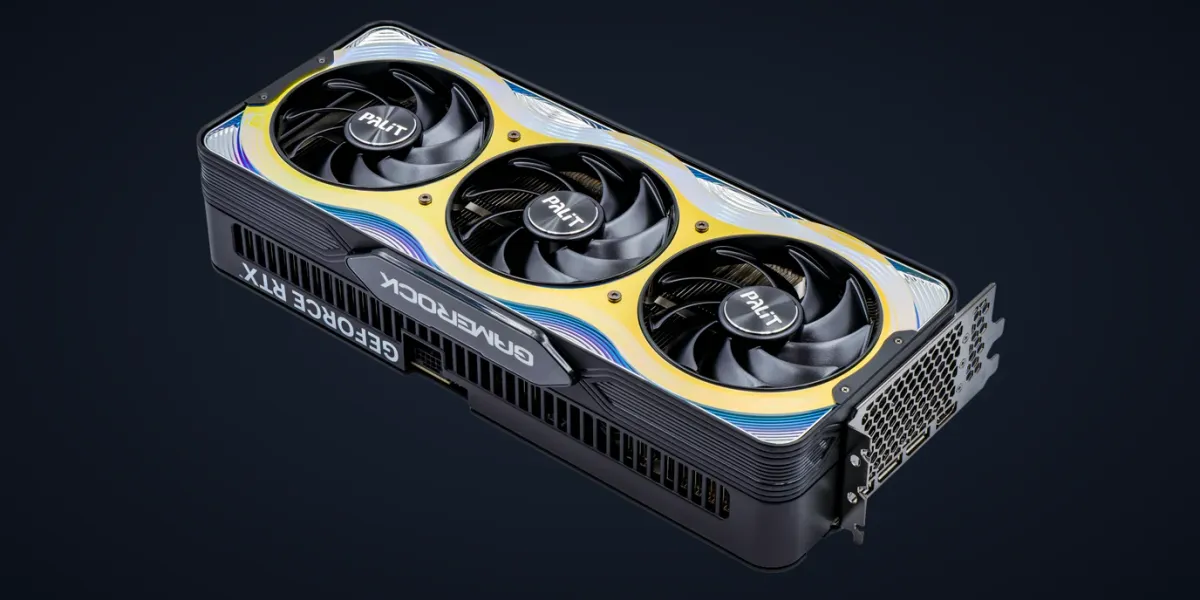
About prices:prices on this page are US street prices in USD, last checked October 2026. They are for reference only. Local prices differ by region and usually include VAT or sales tax, and availability changes quickly, so check the retailer before you buy.
Short answer: it is a leak, not an announcement, but plan as if 32GB GeForce cards are about to get scarcer. On October 10, 2026 Tom’s Hardware reported a leaked factory notice saying NVIDIA will stop making the RTX 5090 and reserve its GB202 chip for professional and data center cards. NVIDIA has not confirmed it. If you need a 5090 for AI work, the roughly $5,000 it costs today is unlikely to improve. If you mainly need VRAM, a used RTX 3090 or 4090 (24GB), two 3090s (48GB), or an RTX PRO 5000 72GB are the paths that do not depend on this rumor.
Quick Navigation:
What Was Actually Reported
The source is a Tom’s Hardware report from October 10, 2026. It cites a notice from an unnamed factory, posted by the hardware leaker @hongxing2020:
“According to a notification from the factory, Nvidia will no longer manufacture any RTX 5090 models, including the D variants. Going forward, the highest-end GeForce graphics card will be the RTX 5080 24GB, while the RTX 5080 16GB version will be discontinued.”
A second well-known leaker, @Zed__Wang, backed the report and added that the GB202 chip will from now on go only into data center and professional cards.
Here is how the claims sort out.
| Claim | Status |
|---|---|
| NVIDIA stopped supplying GB202 chips for RTX 5090 and 5090 D cards | Leak from two sources. Not confirmed by NVIDIA or any board partner. |
| An RTX 5080 24GB becomes the top GeForce card | Same leaked notice. No announcement, price, or date. |
| The RTX 5080 16GB will be discontinued | Same leaked notice. Unconfirmed. |
| RTX 5090 cards disappear right away | Not claimed. Board partners and retailers hold inventory that will keep selling for a while. |
| NVIDIA’s response | None on the record. Tom’s Hardware asked and had no reply at publication. |
Tom’s Hardware itself calls this “an unverified claim and not an official Nvidia announcement.” Keep that in mind for the rest of this page: everything below is about how to plan around a credible rumor, and none of it should be read as a confirmed end-of-life date.
Why the Report Is Plausible
The RTX 5090 shares its chip with cards that sell for far more. GB202 is the silicon inside the GeForce RTX 5090 and inside NVIDIA’s professional Blackwell line. The table shows what NVIDIA can sell around the same chip, using prices reported by Tom’s Hardware in September 2026. The per-GB column is our own arithmetic from those prices.
| Card (GB202) | VRAM | Memory Bandwidth | Price | Per GB of VRAM |
|---|---|---|---|---|
| GeForce RTX 5090 | 32GB | 1,792 GB/s | $1,999 at launch, about $5,000 street (October 2026) | $62 at launch, about $156 now |
| RTX PRO 5000 Blackwell | 48GB | Lower than the 5090 | $7,000 to $9,000 | $146 to $188 |
| RTX PRO 5000 Blackwell | 72GB | About 4% below the PRO 5500 | from $9,209 | about $128 |
| RTX PRO 5500 Blackwell | 84GB | 1,398 GB/s | Not published | Unknown |
| RTX PRO 6000 Blackwell | 96GB | Same as the 5090 | $15,599 | about $162 |
Two things stand out.
At its $1,999 launch price the 5090 was a bargain NVIDIA had every reason to end. A buyer got the same chip as a five-figure professional card for $62 per GB of VRAM. The RTX PRO 5500, launched in September, has the same 21,760 CUDA cores as the 5090 with 84GB of memory in place of 32GB. Same chip, far higher selling price.
At today’s street price the 5090 is no longer cheap VRAM. Around $5,000, it costs about as much per GB as the professional cards, and more than the 72GB PRO 5000. The market already priced in the AI demand. The retail markup goes to distributors and resellers, though, and a discontinuation would let NVIDIA capture that margin itself on PRO cards.
The price history fits the same picture. Tom’s Hardware tracked a median of $4,299 in June 2026, a low of $5,199 at the start of September, and then online stock vanishing by September 14, with third-party sellers asking $6,500 to $9,500. Supply was already thin before this notice surfaced.
What to Buy Instead
Start from how much memory your models need, since that decides everything else. Prices are US street prices as of October 2026 and move weekly.
| Option | VRAM | Street Price, Oct 2026 | Per GB | Good For |
|---|---|---|---|---|
| Used RTX 3090 | 24GB | $1,200 to $1,450 | $50 to $60 | Cheapest 24GB, local LLM inference |
| 2x used RTX 3090 | 48GB | $2,400 to $2,900 | $50 to $60 | More memory than a 5090 for about half the price |
| Used RTX 4090 | 24GB | $2,600 to $3,000 | $108 to $125 | Faster training than a 3090, FP8 support |
| RTX 5090 (new, while stock lasts) | 32GB | about $5,000 | about $156 | Fastest single card, daily training |
| RTX PRO 5000 Blackwell 72GB | 72GB | from $9,209 | about $128 | Large models on one card, workstation use |
| RTX PRO 6000 Blackwell | 96GB | $15,599 | about $162 | Maximum single-card memory at full bandwidth |
If you need a 5090 specifically
Buy from a first-party retailer while stock exists, and do not chase third-party listings. Tom’s Hardware documented marketplace sellers asking $6,500 to $9,500 in September alongside outright scams, including cards sold with the GPU core and memory removed. A new 5090 at around $5,000 only pays off if it trains most days. Our RTX 5090 vs 4090 comparison covers where the extra 8GB and speed matter.
If you mainly run local LLMs
Capacity matters more than raw speed, and used 24GB cards win on capacity per dollar by a wide margin. One 3090 or 4090 runs a 27B dense model such as Qwen3.8-27B at 4-bit (14.3 to 17.6 GB) with room for context. Two 3090s give you 48GB, which is 50% more than a 5090 for about half the money. See our multi-GPU Ollama guide for how models split across cards, and the GPU spec comparison for bandwidth and power figures.
If you need more than 32GB on one card
This is where NVIDIA now wants you: the RTX PRO line. The 72GB PRO 5000 is the best value per GB of the group. The 84GB PRO 5500 has less memory bandwidth than the 5090 (1,398 GB/s against 1,792 GB/s), so it holds more but generates tokens more slowly per GB loaded. If your target is a 100GB-class model and speed is secondary, a unified memory PC costs far less than any of these.
If you train a few hours a week
Rent. A scarcer 5090 makes the buy-versus-rent math worse for occasional users, not better. Vast.ai usually has the lowest hourly prices on 24GB and 32GB cards, and RunPod gives new users a $5 credit to test with. Our rent or buy guide works through the break-even point.
Pro tip: buying a used card in a shortage? Ask for a photo of the card running a stress test with the serial number visible, and prefer platforms with buyer protection. The scams reported this year targeted exactly the high-ticket cards covered here.
Should You Wait for the RTX 5080 24GB?
No, not on the strength of this leak. Three reasons.
It is not announced. There is no price, no date, and no specification beyond a memory size in a leaked notice. Tom’s Hardware notes that an RTX 5080 Super with 24GB has been rumored for a long time and was reportedly postponed because of GDDR7 supply. The memory shortage that delayed it has not ended.
24GB is a capacity you can already buy. A used RTX 3090 or 4090 gives you 24GB today. A 24GB RTX 5080 would be newer and more efficient, but for fitting a model it adds nothing a used card does not already offer.
It would not replace what the 5090 does. The models that need a 5090 need its 32GB: an 8-bit Qwen3.8-27B at 29 to 31.5 GB, for example. A 24GB flagship moves the top of the GeForce line down a tier, and the 32GB-and-up range would belong to the PRO cards alone.
There is also no next generation close behind. Tom’s Hardware reports that the Rubin-based RTX 60 series is not expected until late 2027 or 2028, which is itself a rumor. If the 5090 does go away, the top GeForce slot could sit at 24GB for a long time. Our best GPUs for deep learning guide tracks the current picks and prices.
We will update this page when NVIDIA or a board partner confirms or denies the report.
FAQ
Is the RTX 5090 discontinued?
Not officially. On October 10, 2026 Tom’s Hardware reported a leaked factory notice, relayed by the leaker hongxing2020 and backed by a second leaker, saying NVIDIA will no longer manufacture any RTX 5090 models. NVIDIA has not confirmed it and had not answered Tom’s Hardware’s request for comment. Treat it as a credible rumor, not a fact.
Should I buy an RTX 5090 now for AI work?
Only if you need 32GB on a single card and the GPU will be busy most days. In October 2026 a new RTX 5090 costs around $5,000 in the US, two and a half times its $1,999 launch price. If the report is true, supply shrinks from here and prices are more likely to rise than fall. If you were waiting for a drop back toward MSRP, this report makes that less likely, not more.
What is the best RTX 5090 alternative for local LLMs?
For capacity per dollar, a used RTX 3090 with 24GB at roughly $1,200 to $1,450 (US street price, October 2026), or two of them for 48GB. A used RTX 4090 is faster and has 24GB at roughly $2,600 to $3,000. If you need more than 32GB on one card, the RTX PRO 5000 72GB starts at $9,209 and the RTX PRO 6000 96GB retails for $15,599.
Is the RTX 5080 24GB real?
It is a rumor. The same leaked notice says the highest-end GeForce card will become an RTX 5080 24GB and that the 16GB RTX 5080 will be discontinued. NVIDIA has not announced the card, a price, or a date. Earlier reports said the RTX 50 Super refresh, including a 24GB RTX 5080 Super, was postponed because of GDDR7 supply.
Why would NVIDIA stop making its best gaming GPU?
The RTX 5090 uses the same GB202 chip as NVIDIA’s professional RTX PRO cards, which sell for $9,000 to $15,600 with more memory attached. With chip and GDDR7 supply limited, every GB202 that goes into a GeForce card is one that cannot go into a card that sells for two to three times as much.
Related Reading
Best GPUs for Deep Learning 2026
Current picks at real street prices
RTX 5090 vs 4090 for Deep Learning
Where 32GB and the extra speed matter
Multi-GPU Ollama Setup
Running two 24GB cards as one 48GB pool
Unified Memory PCs for Local LLMs
100GB-class memory without a pro GPU
Cloud GPU vs Local GPU
When renting beats a $5,000 card
Qwen3.8-27B Hardware Guide
A strong model that fits one 24GB card
Picking a GPU for an AI Rig?
Want a build specced around the cards you can actually get? See our Tailored Builds page.