About prices:prices on this page are US street prices in USD, last checked November 2026 for GPUs, Ryzen CPUs, and desktop RAM, and October 2026 for other parts. They are for reference only. Local prices differ by region and usually include VAT or sales tax, and availability changes quickly, so check the retailer before you buy.
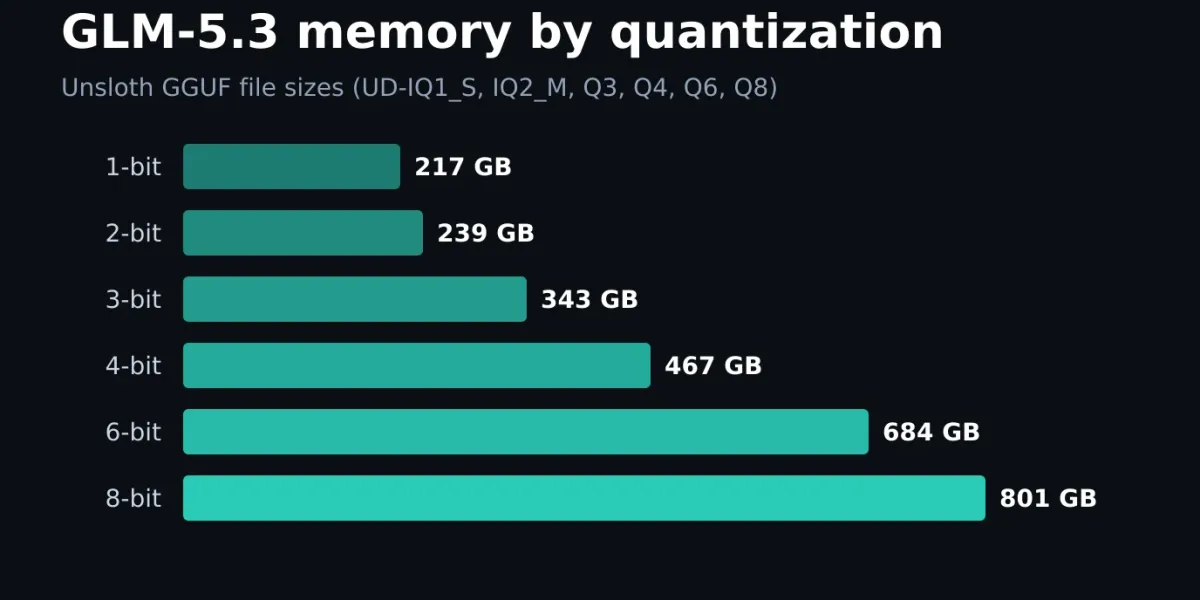
Short answer: GLM-5.3 needs at least 256 GB of combined memory, and no consumer GPU can hold it alone. The published GGUF files are 217 GB at 1-bit, 239 to 254 GB at 2-bit, and 467 GB at the larger 4-bit build. A 256 GB Mac Studio or a workstation with 256 GB of RAM is the entry point. If you have 128 GB, run GLM-5.3-Flash instead, which starts at 93 GB and uses the MIT license.
Quick Navigation:
What Changed From GLM-5.2
Z.ai says GLM-5.3 uses the same base model as GLM-5.2, and that every gain comes from post-training. That matters for hardware: if your machine runs GLM-5.2, it can hold GLM-5.3 at about the same quantization. Our GLM-5.2 hardware guide covers that earlier release.
The improvement is mostly in coding and long agent tasks. Z.ai reports a 50% gain over GLM-5.2 on its in-house Code Bench, and Terminal Bench 3.0 rose from 4.6 to 28.3 on its model card. These are the vendor’s own results.
GLM-5.3 vs GLM-5.3-Flash
Z.ai released a smaller sibling the same month, and for most local users Flash is the model to look at first.
| Spec | GLM-5.3 | GLM-5.3-Flash |
|---|---|---|
| Total parameters | About 744B | About 320B |
| Active per token | About 40B | About 18B |
| Input | Text | Text and images |
| Context | 1M tokens | 1M tokens |
| FP8 checkpoint | 755.6 GB | 328.3 GB |
| Smallest GGUF | 216.7 GB | 93.1 GB |
| License | Custom GLM-5.3 License | MIT |
Sources report slightly different parameter counts for the full model, from 743B to 753B. The difference does not change any hardware decision.
The license catch is narrow. The GLM-5.3 License allows commercial use, modification, and redistribution. Only a Model-as-a-Service operator whose group revenue exceeds $10 billion over any 12 months must pass a Z.ai security review before commercial use.
Real Memory by Quantization
These sizes are from Unsloth’s GLM-5.3 and GLM-5.3-Flash GGUF repositories, read from the Hugging Face API on November 22, 2026. “Memory” means VRAM plus system RAM combined. Leave extra room for the KV cache.
| Level | GLM-5.3 | Smallest Fit | GLM-5.3-Flash | Smallest Fit |
|---|---|---|---|---|
| 1-bit | 217 to 229 GB | 256 GB | 93 to 98 GB | 128 GB |
| 2-bit | 239 to 254 GB | 256 GB (tight), 384 GB | 102 to 109 GB | 128 GB (tight) |
| 3-bit | 282 to 343 GB | 384 GB | 120 to 148 GB | 192 GB |
| 4-bit | 365 to 467 GB | 512 GB | 157 to 200 GB | 256 GB |
| 5-bit | 563 GB | 8x H200 | 240 GB | 384 GB |
| 6-bit | 684 GB | 8x H200 | 292 GB | 384 GB |
| 8-bit | 801 GB | 8x H200 | 341 GB | 512 GB |
The “smallest fit” columns are our reading of common memory sizes, not vendor requirements. Unsloth says its 239 GB 2-bit build works well on 256 GB devices such as a Mac Studio or two linked DGX Sparks.
Lower bits cost quality. Unsloth’s own quality table lists a top-1 score of 72.56% for the 217 GB build, 78.53% for the 239 GB build, and 94.29% for the 467 GB 4-bit build. If accuracy matters, GLM-5.3-Flash at a higher quant may serve you better than the full model at 1-bit, so test both on your own tasks.
Measured Speed
We have not run this model ourselves, and we found no published GLM-5.3 speed measurements on consumer or workstation hardware. The best public data comes from NVIDIA’s November 13 test on two linked DGX Stations, each with one GB300 GPU, using the 464 GB NVFP4 checkpoint in vLLM.
| Concurrent Requests | Total Throughput | Mean Request Time |
|---|---|---|
| 1 | 107.4 tok/s | 49.8 s |
| 8 | 386.0 tok/s | 114.2 s |
| 16 | 607.8 tok/s | 136.5 s |
| 32 | 385.0 tok/s | 453.5 s |
The headline 607.8 tokens per second is a total across 16 requests. Each user saw about 42.4 tokens per second. Past 16 requests, throughput fell and waits grew sharply. This is datacenter-class hardware with 252 GB of HBM3e per GPU, so do not expect these speeds on a Mac or a RAM-offload build.
Hardware Paths
128 GB: Run GLM-5.3-Flash
A DGX Spark, RTX Spark, or Ryzen AI Max+ box can hold the 93 to 98 GB 1-bit Flash builds. The full model does not fit. Our unified memory guide compares these machines.
256 GB: Mac Studio or RAM Offload
The entry point for the full model at 1-bit or the 239 GB 2-bit build. On a PC, llama.cpp keeps attention layers on a single 24 GB or 32 GB GPU and streams experts from system RAM. Speed is limited by RAM bandwidth, so favor a multi-channel platform. See the RAM guide.
384 to 512 GB: Better Quality
Four RTX PRO 6000 cards (384 GB) hold the 3-bit builds fully in VRAM. A 512 GB Mac Studio reaches the 4-bit builds, with less room for context at the 467 GB size. See our multi-GPU guide.
Rent an 8x H200 Node
The vLLM recipe runs the 755.6 GB FP8 checkpoint on eight H200s with 141 GB each. This is the practical way to use full quality without owning a server. Vast.ai usually has the lowest hourly prices, and RunPod gives new users a $5 credit. Compare options on our cloud GPU page.
Which One Should You Run?
If you have 128 GB, run GLM-5.3-Flash. If you have 256 GB, compare the full model at 2-bit with Flash at 4-bit, since Flash keeps far more precision at that size. If you need the best quality, rent an H200 node rather than buying hardware for one model.
Do you need to run it locally at all? If the goal is simply to try it, start with a rental or a hosted endpoint, then buy only if privacy or steady daily use justifies it. For a similar-class alternative, see our Mistral Large 4 guide.
FAQ
How much memory does GLM-5.3 need?
Unsloth’s GGUF builds are 217 GB at 1-bit, 239 to 254 GB at 2-bit, 282 to 343 GB at 3-bit, 365 to 467 GB at 4-bit, and 801 GB at 8-bit. Plan for at least 256 GB of combined memory. The official FP8 checkpoint is 755.6 GB.
Can you run GLM-5.3 on an RTX 5090?
Not on the GPU alone. Even the 217 GB build is about seven times the 5090’s 32 GB. A single GPU can handle part of the work in a MoE offloading setup, but you still need 256 GB or more of system RAM.
What is the difference between GLM-5.3 and GLM-5.3-Flash?
GLM-5.3 has about 744B total and 40B active parameters and uses a custom license. GLM-5.3-Flash has about 320B total and 18B active parameters, accepts images, and uses the MIT license. Flash GGUFs start at 93 GB, so it is the realistic choice for a 128 GB machine.
Can a 128GB DGX Spark or RTX Spark run GLM-5.3?
Not the full model. A 128 GB machine can hold GLM-5.3-Flash at 1-bit or 2-bit, where the GGUF files are 93 to 109 GB. The 109 GB build leaves little room for context, so the smaller Flash quants are the safer choice.
Is GLM-5.3 free for commercial use?
For almost everyone, yes. The GLM-5.3 License allows commercial use and modification. A Model-as-a-Service operator whose group revenue exceeds $10 billion in any 12 months must pass a Z.ai security review before commercial use. GLM-5.3-Flash uses plain MIT.
How fast is GLM-5.3 locally?
We found no published measurements on consumer or workstation hardware. The strongest measured figure is from NVIDIA: two linked DGX Stations running the NVFP4 build reached 107.4 tokens per second for one request and 607.8 tokens per second in total across 16 concurrent requests.
Related Reading
Building for Big Local Models?