About prices:prices on this page are US street prices in USD, last checked October 2026. They are for reference only. Local prices differ by region and usually include VAT or sales tax, and availability changes quickly, so check the retailer before you buy.
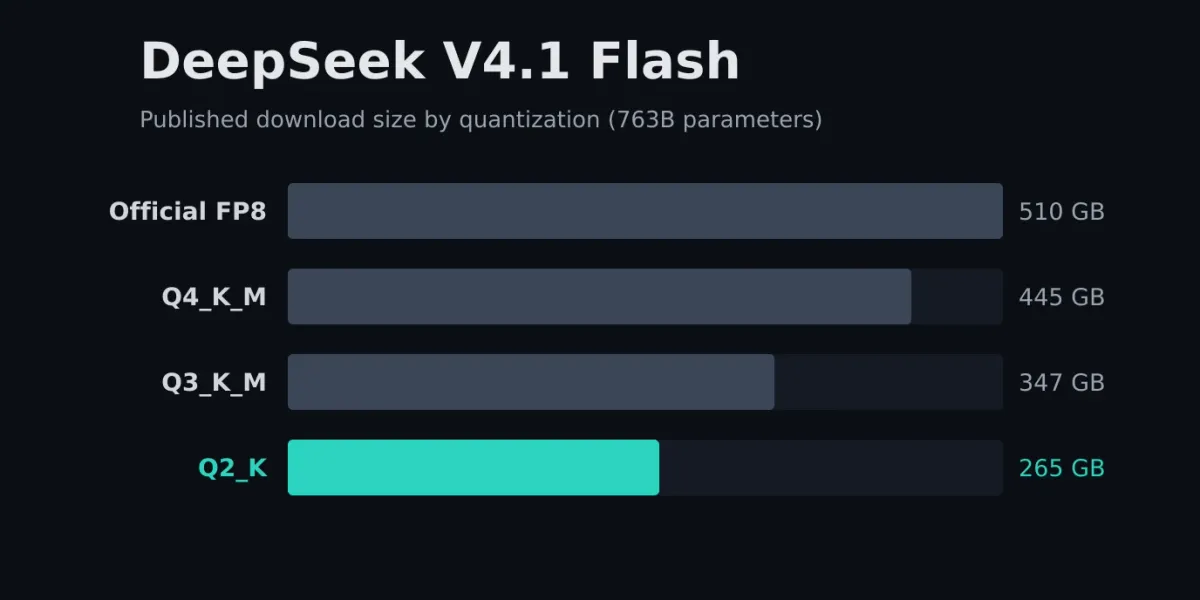
Short answer: DeepSeek V4.1 Flash is a 763B-parameter download, about 2.5 times the size of V4 Flash, and no single GPU holds it. The official FP8 weights are about 510 GB and the smallest common GGUF is about 265 GB at 2-bit. The surprise is how little of it has to be in fast memory: only 8B to 16B parameters fire per token, so engines that stream from SSD run it on a 128 GB Mac at 10 to 19 tokens per second. For all-GPU serving you need four 96 GB cards or a rented 4x H200 node, and the API is cheaper than either for most workloads.
Quick Navigation:
What Changed From V4 Flash
DeepSeek released V4.1 Flash on September 10, 2026. The launch post passed 1,000 points on Hacker News, and Hugging Face shows more than a million downloads of the official weights in the past month. The name suggests a point release. The weights say otherwise. All figures below come from DeepSeek’s model card and the repository’s own file metadata.
| Spec | V4 Flash | V4.1 Flash |
|---|---|---|
| Backbone parameters | 284B | 552B |
| Engram memory table | None | 196B parameters, accessed by token lookup |
| Total in the checkpoint | 284B | 763B |
| Active per token | 13B | 8B during prefill, 16B during decode |
| Input | Text | Text and images |
| Global KV cache per token | About 4x larger | 890 bytes |
| License | MIT | MIT |
Two of these rows decide the hardware story.
The total is what you have to store. At 763B parameters, V4.1 Flash is in the same weight class as GLM-5.2 (744B), not the 284B V4 Flash it replaces. A machine sized for V4 Flash, which runs in about 92 GB, will not hold it.
The active count is what you have to compute. Only 8B parameters fire per token while reading the prompt and 16B while writing, out of 384 routed experts per layer with 6 active. The 196B Engram table is described by DeepSeek as “sparsely accessed via token-based lookup,” so a given token touches a handful of rows. That combination is why this model tolerates having most of its weights on an SSD far better than a dense model would.
The model supports contexts of up to one million tokens, and the small KV cache is what makes that practical. DeepSeek puts the global KV cache at 890 bytes per token, about a quarter of V4 Flash, so a 100,000-token context costs about 89 MB of it. Long contexts are cheap here in a way they are not for Mistral Large 4 or GLM-5.2.
Published Sizes by Quantization
These are real file sizes read from the Hugging Face repositories on October 12, 2026, converted to decimal GB. They are download sizes, and they are not measurements we ran.
| Build | Format | Download Size | Source |
|---|---|---|---|
| Official weights | FP8 safetensors | 510 GB | deepseek-ai |
| NVFP4 | safetensors | 527 GB | nvidia |
| Q8_0 | GGUF | 508 GB | vcruz305 |
| Q4_K_M | GGUF | 445 GB | vcruz305 |
| Q3_K_M | GGUF | 347 GB | vcruz305 |
| Q2_K | GGUF | 265 GB | vcruz305 |
| 2-bit with MTP | MLX | 239 GB | TensorFold |
| DwarfStar Q4 | GGUF, FP8 Engram | 519 GB (316 GB main weights) | antirez |
| DwarfStar Q2 | GGUF, FP8 Engram | 366 GB (163 GB main weights) | antirez |
The last two rows show the split that matters. The DwarfStar builds keep the Engram table at its native FP8 precision, which takes about 203 GB of each file, and quantize only the main weights. The engine “reads the needed rows directly from disk; it never makes the whole table resident.” So the 2-bit build is a 366 GB download with about 163 GB of weights that want to be in memory, before context and runtime buffers.
Key insight: budget storage as carefully as memory. Every build of this model is 240 GB to 530 GB on disk, and the engines that make it usable on small machines read from that disk on every token. A fast NVMe drive is part of the inference path here, not just where the file is kept. See our NVMe guide for AI storage.
Hardware That Runs It
Path 1: A 128 GB Mac With SSD Streaming
The most accessible route. DwarfStar, the Metal engine by antirez, runs the 2-bit build on a single 128 GB Mac with –ssd-streaming. The Argodrive project published measurements on a 128 GB M5 Max with the 4-bit build: 10.18 tokens per second of steady decode on the stock engine, 18.66 with its fork on the same internal SSD, and 22.25 with expert reads spread across three drives. Time to first token on a 512-token prompt was 31.5 seconds stock and 18.3 seconds on the fork. Those are the project’s own numbers from one test session. Our unified memory PC guide compares the machines in this class.
Path 2: A 512 GB Mac Studio, Fully in Memory
The DwarfStar model card names a 512 GB Mac as the target for holding the 4-bit build fully resident, and says the 2-bit build fits resident on “a larger Mac” than 128 GB or across two 128 GB Macs linked with RDMA. Full residency removes the disk from the token path, which should help most with time to first token on long prompts. No published speed figures for this configuration were available when this guide was written.
Path 3: A 64 GB Laptop, Mostly From Disk
The WARP engine keeps the model trunk in memory, streams the selected experts from disk, and uses spare RAM as a cache. Its README reports V4.1 Flash at 3.77 tokens per second on a 64 GB MacBook Pro with an M5 Pro, from a 299 GB container with a minimum of 4.86 GB of RAM. That is slow for interactive coding and fine for overnight or batch jobs. It is also experimental software, so treat it as a proof that the approach works more than as a daily driver.
Path 4: A Multi-GPU Workstation
By file size alone, four RTX PRO 6000 Blackwell cards (384 GB total) hold the 265 GB Q2_K or the 347 GB Q3_K_M build with room for context, and do not hold Q4_K_M at 445 GB. Two 96 GB cards (192 GB) are too small for any full build unless the engine keeps the Engram table off the GPUs. This is arithmetic from published sizes, not a tested configuration, and at $15,599 per card it is a $62,000 GPU bill before the rest of the machine. See the GPU spec comparison and our multi-GPU setup guide.
Path 5: Rent a 4x H200 Node
Four H200s give you 564 GB of VRAM, enough for the official 510 GB FP8 weights. This is the configuration a real company tested, covered in the next section. Vast.ai usually has the lowest hourly prices on multi-GPU nodes, and RunPod gives new users a $5 credit to test with. Our cloud GPU comparison has current pricing.
What does not make the list: any single consumer GPU, and any 24 GB or 32 GB card paired with ordinary desktop RAM in the way that worked for V4 Flash. The model is simply too large for that approach at a usable speed.
What a 4x H200 Rental Actually Cost
The best real-world data point so far comes from a test covered by Tom’s Hardware on October 1, 2026. A consultancy rented a four-H200 server to serve V4.1 Flash to its coding agents and published the bill.
| Measure | Reported Figure |
|---|---|
| Peak output on its real coding mix | About 213 tokens per second for the whole server |
| On-demand rate | $18.37 per hour, $440.88 per day |
| Spot rate | $9.19 per hour, and the provider reclaimed the box |
| A full month on demand | About $13,200 (Tom’s Hardware’s arithmetic) |
| Same work on DeepSeek’s API | $184 to $223 per day |
| Getting it stable | Five tries, 10 to 15 minutes of loading each |
The lesson is about workload shape. The firm’s agents resend the conversation on every call, and 96% of what they sent was text the model had already seen. The server spent most of its time re-reading and little of it writing. DeepSeek’s API prices cached input at $0.003 per million tokens against $0.15 for new input and $0.60 for output (off-peak, per the same report), so the API charges almost nothing for exactly the work that kept the rented box busy.
Rent or self-host when your data cannot leave your network, or when you can keep the hardware busy around the clock. Use the API when cost is the goal. At these prices, a rented node loses to the API on agent workloads by a factor of two or more.
Pro tip: the official release ships without a Jinja chat template. DeepSeek provides a reference Python encoder in the repository’s encoding folder and a separate deepseek-recipe toolkit for production use. If a serving stack gives you garbled tool calls, check that it implements the V4.1 prompt format before blaming the quantization.
Which Path Makes Sense
- You own a 128 GB Mac: try the DwarfStar 2-bit build with SSD streaming. It is the only way most people can run this model at a conversational speed.
- You own a 24 GB or 32 GB GPU rig: stay on Qwen3.8-27B or V4 Flash 0731 locally and use V4.1 through the API.
- You are sizing a new machine for it: wait a few weeks if you can. The engines are improving quickly. One project reported an 83% decode speedup over the stock engine in September from read scheduling alone.
- You want it for a team: price the API first, then a rented node, and only then hardware.
We will update this guide as more speed measurements are published.
FAQ
How much memory does DeepSeek V4.1 Flash need?
The official FP8 checkpoint is about 510 GB. Community GGUF builds are about 265 GB at Q2_K, 347 GB at Q3_K_M, and 445 GB at Q4_K_M. Not all of that has to sit in memory: about 203 GB of every build is the Engram lookup table, which some engines read from SSD. In the DwarfStar 2-bit build the weights that must be in memory are about 163 GB.
Can you run DeepSeek V4.1 Flash on a single GPU?
Not in VRAM. No single GPU holds 265 GB, and the largest workstation card has 96 GB. Running it fully on GPUs takes four 96 GB cards for a 2-bit or 3-bit build, or four H200s for the official FP8 weights.
Can a Mac run DeepSeek V4.1 Flash?
Yes, with SSD streaming. The DwarfStar engine runs the 2-bit build on a single 128 GB Mac by keeping the main weights in memory and reading the rest from disk. One published measurement on a 128 GB M5 Max reached 10.18 tokens per second on the 4-bit build with the stock engine and 18.66 with an optimized fork. A 512 GB Mac holds the 4-bit build fully in memory.
Is DeepSeek V4.1 Flash bigger than V4 Flash?
Much bigger. V4 Flash has a 284B-parameter backbone and runs in about 92 GB. V4.1 Flash has a 552B backbone plus a 196B Engram memory table, and the published checkpoint totals 763B parameters. Hardware sized for V4 Flash will not hold V4.1.
Is it cheaper to rent GPUs or use the DeepSeek API?
For most people, the API. A consultancy that rented a 4x H200 server for V4.1 Flash paid $18.37 per hour on demand, about $13,200 a month by Tom’s Hardware’s arithmetic, while the same workload on DeepSeek’s API would have cost $3,500 to $7,000. Renting only makes sense for privacy or for steady high-volume use.
Related Reading
DeepSeek V4 Flash Hardware Guide
The 284B predecessor that still fits in 92 GB
GLM-5.2 Hardware Guide
A 744B model in the same weight class
Strata: 125B on a 12GB GPU
Another engine that streams experts from disk
Unified Memory PCs for Local LLMs
Mac Studio, DGX Spark, and Ryzen AI Max compared
Best NVMe SSD for AI Storage
The drive is in the token path for this model
Cloud GPU Providers
Rent H200 nodes by the hour
Building for Big Local Models?
Need a workstation with fast storage and room for several GPUs? Check our Tailored Builds page.